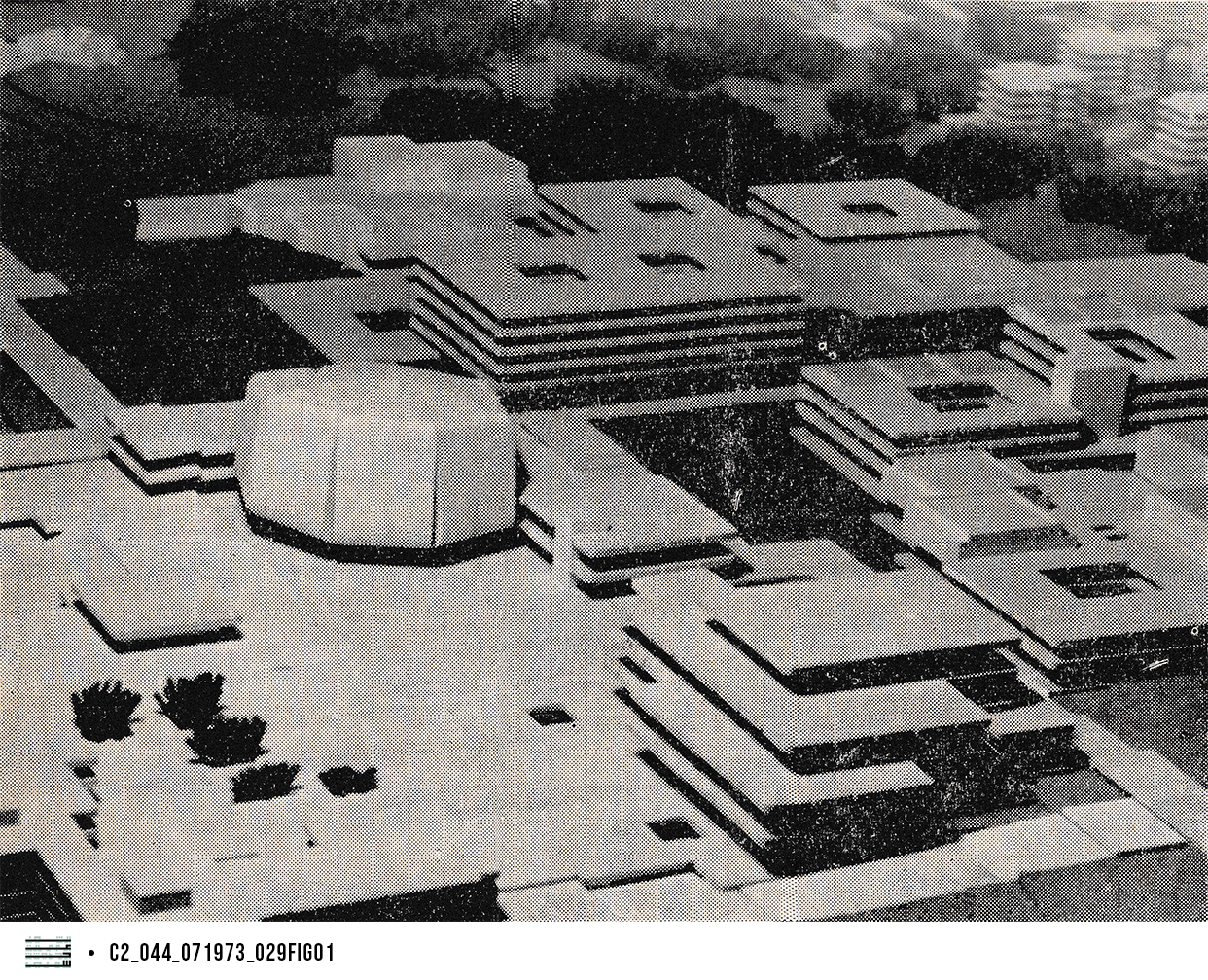
Latakia University was established under legislative Decree No. 12 of 1971 to meet the growing demand for university education and the country’s need for specialists in various scientific and technical fields during the 1970s.01 It was the third university to be established in Syria, following Damascus University, founded in the late Ottoman era, and Aleppo University, established in 1958.
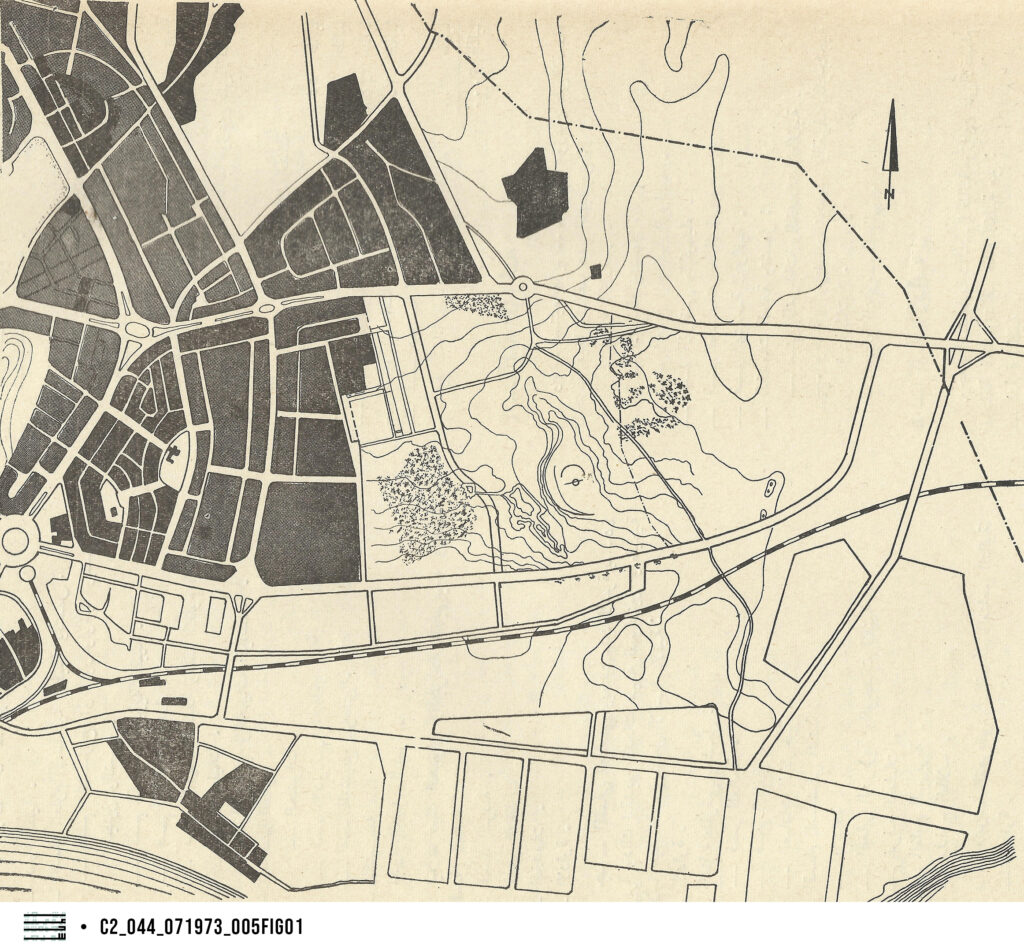
The university campus is located at the eastern entrance to the city, bordered to the north and south by main roads. It overlooks the sea to the south and al-Kabir al-Shamali River to the east, and is surrounded by residential areas to the west and north. The land slopes gently from north to south, and a small valley runs along its eastern edge. Olive groves and scattered trees are also present at the site.02
A committee, chaired by Salim Yassin and including Antoine Qassis, Alaa al-Din Loulah, Adnan Jazmati, and Suhail Sidawi, was formed to visit engineering firms in France, Switzerland, West Germany, and Italy to select a firm to participate in a closed competition for the design of the Latakia University campus.03
In France, the committee visited the International Union of Architects (UIA) and met with Mr. Michel Weill, then National Union of French Architects (UNSFA) with Mr. Picot, where they got a list of qualified firms. The UIA also expressed its willingness to provide the committee with names of international judges for the competition. In Italy, the committee met with Mr. Ranzo Ciadetti, who abstained from providing relevant information. They also visited the office of Architect Oscar Niemeyer, which declined to participate in the competition, proposing a direct contract. However, the committee rejected this, preferring the competition. Architects Jean-François Zevaco, Charles-Édouard Geisendorf, Hans Georg Otto, Bernard H. Zehrfuss, and Alfred Roth also declined due to financial reasons or other commitments.04
The firms that expressed their willingness to participate are: Jean Dubuisson, Henri Bernard, André Wogensk, George Candilis, Andrault et Parat, Riboulet, Thurnauer, et Vert, Rambald Von Steinbuchel, Massimo Pica Ciamarra, and Hanz Zwimpfer. The initial program and general terms were revised, and six firms were shortlisted for the competition: Henri Bernard (who later withdrew), George Candilis, Jean Dubuisson, Massimo Pica Ciamarra, Rambald Von Steinbuchel, and Hanz Zwimpfer.05
The university invited several architects to express their interest in joining the jury that would select the winning design for the Latakia University project. Some accepted the invitation to participate, while others declined. Ultimately, the following jury was formed:
- Jan Piet Kloos – Full Member
- Félix Candela – Alternate Member
- César Lăzărescu – Full Member
- Jean-François Zevaco – Full Member
- Alaa El-Din Loulah – Full Member
- Souhail Sidawi – Full Member
- Salim Yassin – Non-Voting Member
01 Ahmad Imam, “Fikra ʿan Barnāmaj Musābaqat Jāmiʿat al-Lādhiqiyya [Conceptual Notes on the Latakia University Design Competition Program],” Arab Engineer Magazine, July 1973, 4–9. The Arab Engineer magazine collection, Archive of Modern Architecture in Syria (AMASyria).
02 Concours International Sur Invitation Pour Le Projet De Construction De L’Université: 1973 Lattaquié République Arabe Syrienne (Lattakia: 1973).
03 Suheil Sedawi, “Musābaqat Jāmiʿat al-Lādhiqiyya wa-Intiqāʾ Lajnat al-Taḥkīm [The Latakia University Competition and the Selection of the Jury Committee,]” The Arab Engineer Magazine, July 1973,10-12. The Arab Engineer magazine collection, Archive of Modern Architecture in Syria (AMASyria).
04 Sedawi, “[The Latakia University Competition and the Selection of the Jury Committee,]” 10-12.
05 Ibid
06 Imam, “[Conceptual Notes on the Latakia University Design Competition Program],” 4–9.
The Latakia University Design Competition program included the following:06
- Faculties
- A Faculty of Science: Five departments and annexes, accommodating 5,000 students (3,000 from its own students and 2,000 from other faculties), in a central location serving the other faculties.
- A Faculty of Medicine: Includes the faculty building, the animal house, the university hospital (450 beds), the nursing school, and the public health research center, with a capacity of 1,500 students.
- A Faculty of Engineering: Capacity of 2,000 students.
- A Faculty of Agriculture: Capacity of 3,000 students.
- A Faculty of Arts: Capacity of 4,000 students.
- Intermediate Institutes
- Intermediate Engineering Institute – 700 students.
- Institute of Petroleum and Mineral Studies – 800 students.
- Intermediate Agricultural Institute – 1000 students.
- Teacher Training Institute.
- Public Facilities and Services
- University Administration Building, Student Affairs, and Central Library.
- Student Housing for 2000 students (single rooms, 150 students per unit).
- The Grand Auditorium, University Student Center (self-service restaurant, cinema, and theater for 600 people).
- A small shopping center, Student Club and Union, University Clinic, Printing Press, and Publications Department.
- Sports City
- A stadium with a capacity of 5000 spectators and multiple courts (football, handball, basketball, volleyball, and tennis).
- A gymnasium and a winter swimming pool that can be converted to a summer pool.
- A wing for receiving sports delegations, including rooms for male and female athletes.
General Administration, Supervision and Maintenance Offices, and Service Facilities.
- Public Services
- Mail and communications, workshops, garages, central heating, roads, parking, and gardens.
The program emphasized the need to plan for future expansion by adding new faculties and specializations in line with the development plan. It specified that the work would be completed in two phases, with the first phase beginning within six months. During this phase, a 1:1000 scale general plan, a 1:500 scale model, preliminary 1:500 scale drawings, an explanatory memorandum, and a cost estimate would be submitted. A reward of 75,000 Syrian pounds (approximately 19,000 USD at the time) would be given as an initial payment to the winning firm, which would then be automatically contracted to complete the second phase.
The program outlined the order of construction work, beginning with the Faculty of Science, the Faculty of Medicine, and the University Hospital, followed by the Faculties of Engineering and Agriculture, then the Faculty of Arts, then public facilities, and finally intermediate institutes. A timetable was to be prepared in coordination with the contracted firm to complete the studies within 14 months.
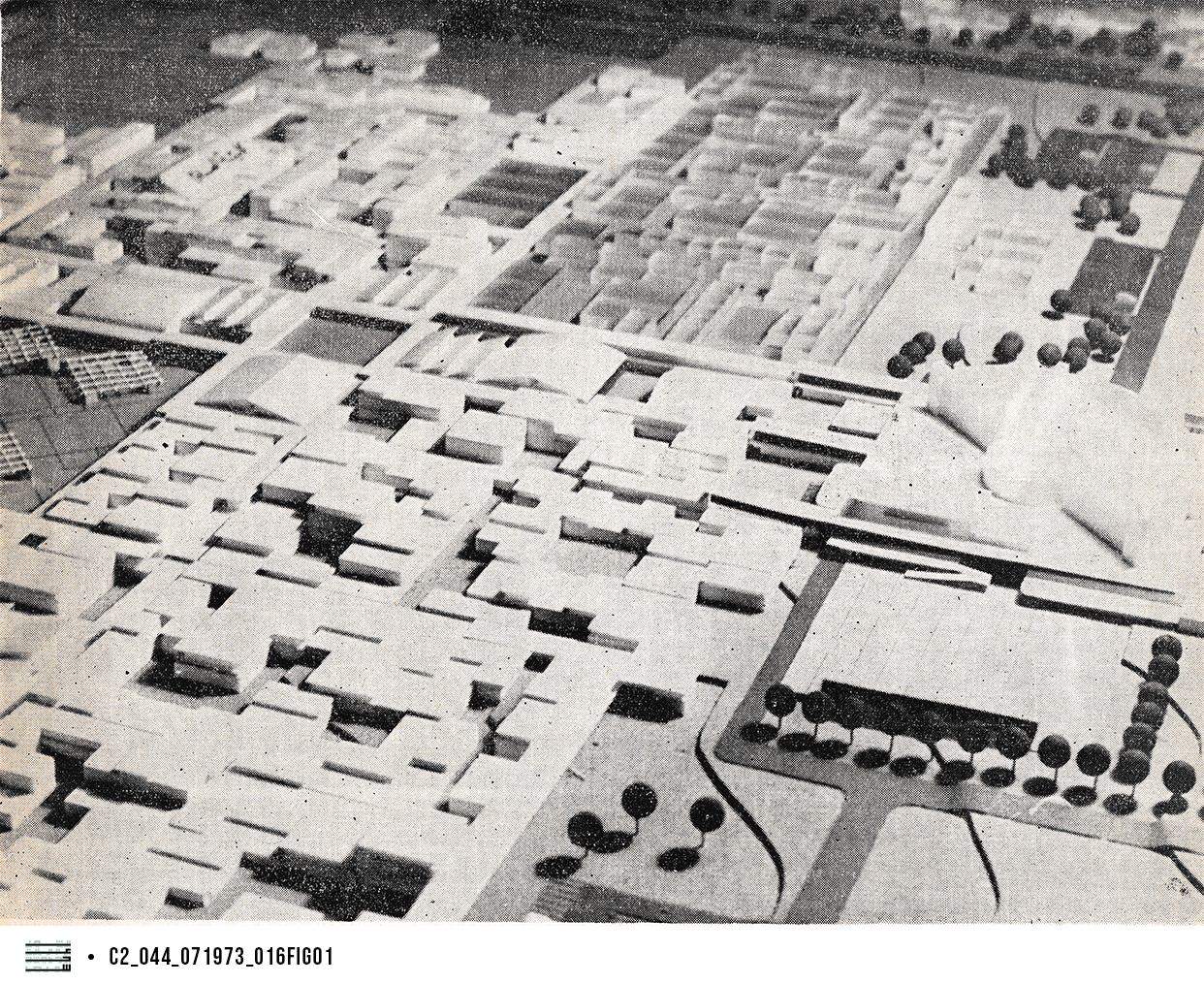
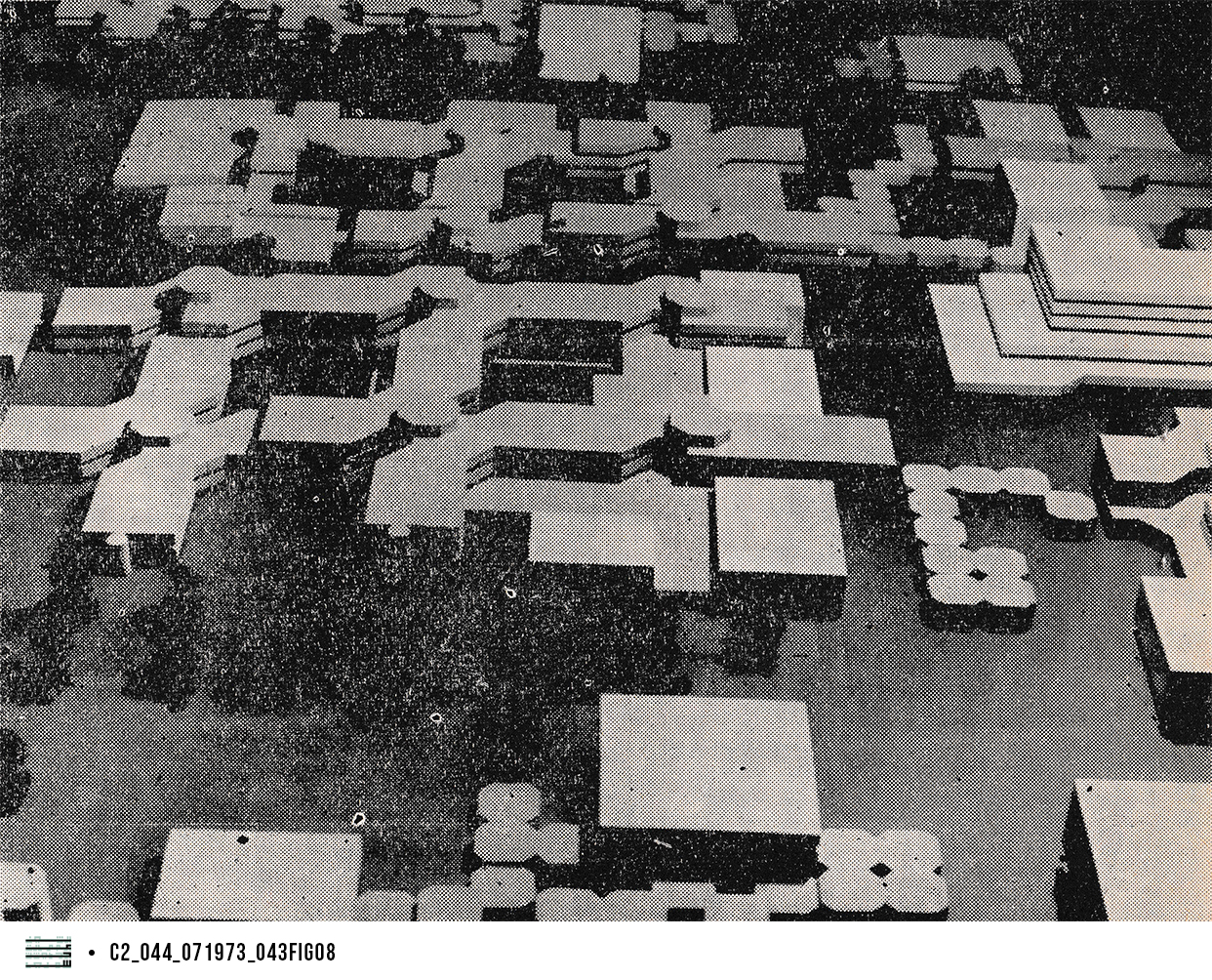
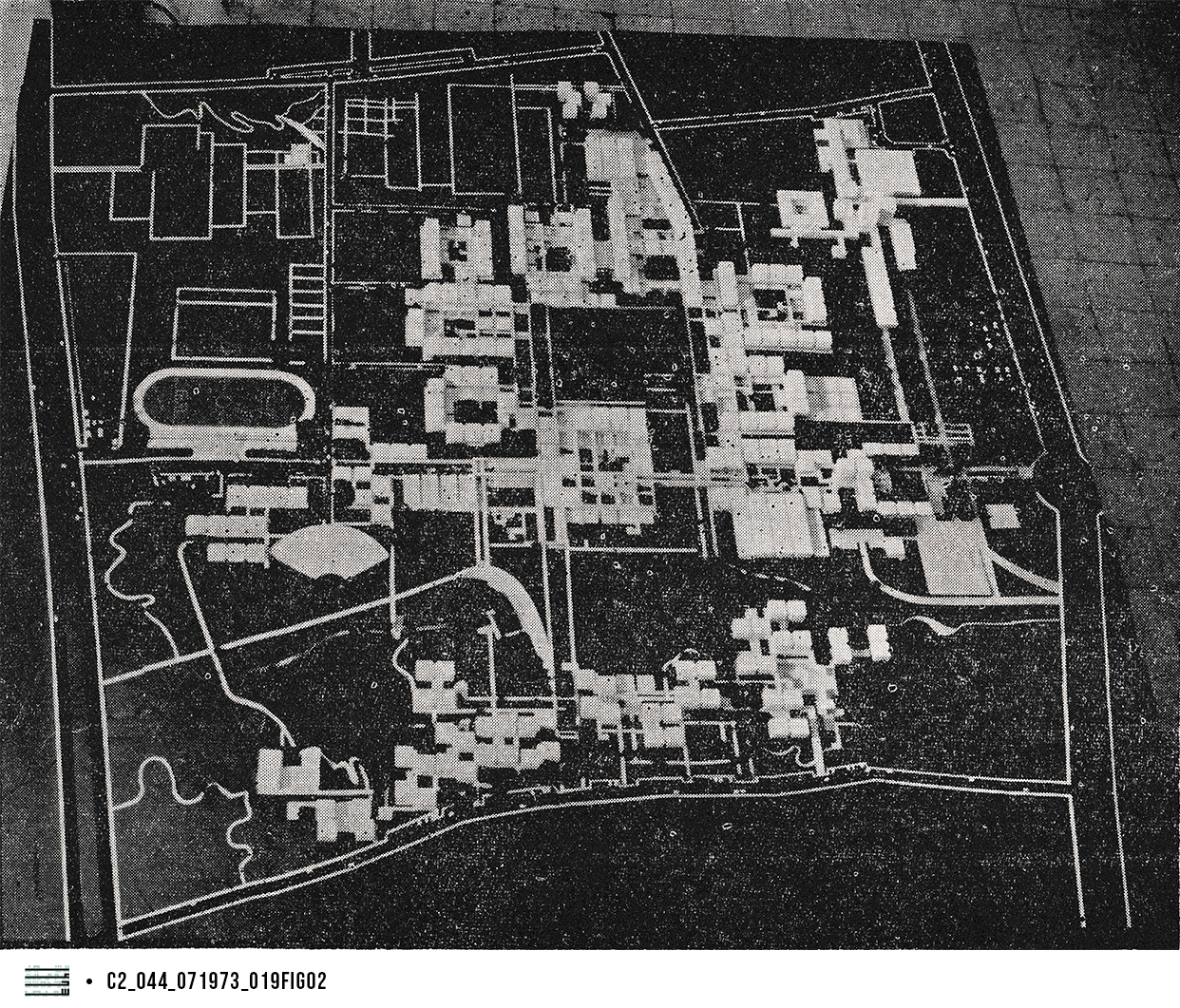
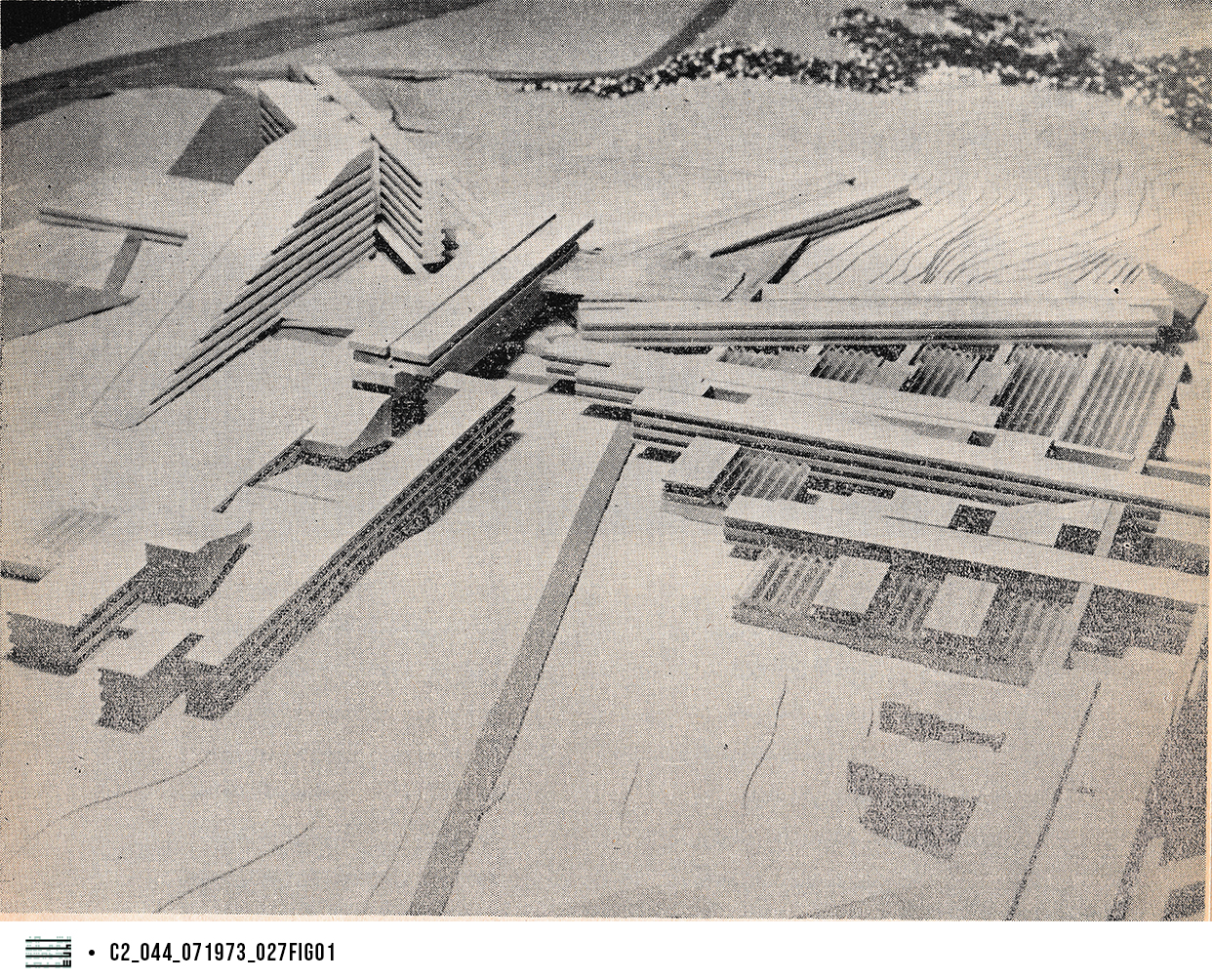
The participating firms were given the order to commence work and submitted their studies on March 25, 1973. The judging committee met on April 16, 1973, in Latakia to review the projects after visiting the site, examining the documents, and listening to the competitors, with the exception of Jean Dubuisson, who apologized from attending.07 The jury’s work concluded with a recommendation to Latakia University to adopt the project submitted by architect Rambald Von Steinbuchel, who was considered the winner in the university’s design competition.
07 Naaman al-Zein, “Taqrīr Lajnat al-Taḥkīm [The Jury Committee Report],” The Arab Engineer Magazine, July 1973. 44-51. The Arab Engineer magazine collection, Archive of Modern Architecture in Syria (AMASyria).
01 Ahmad Imam, “Fikra ʿan Barnāmaj Musābaqat Jāmiʿat al-Lādhiqiyya [Conceptual Notes on the Latakia University Design Competition Program],” Arab Engineer Magazine, July 1973, 4–9. The Arab Engineer magazine collection, Archive of Modern Architecture in Syria (AMASyria).
02 Concours International Sur Invitation Pour Le Projet De Construction De L’Université: 1973 Lattaquié République Arabe Syrienne (Lattakia: 1973).
03 Suheil Sedawi, “Musābaqat Jāmiʿat al-Lādhiqiyya wa-Intiqāʾ Lajnat al-Taḥkīm [The Latakia University Competition and the Selection of the Jury Committee,]” The Arab Engineer Magazine, July 1973,10-12. The Arab Engineer magazine collection, Archive of Modern Architecture in Syria (AMASyria).
04 Sedawi, “[The Latakia University Competition and the Selection of the Jury Committee,]” 10-12.
05 Ibid
06 Imam, “[Conceptual Notes on the Latakia University Design Competition Program],” 4–9.
07 Naaman al-Zein, “Taqrīr Lajnat al-Taḥkīm [The Jury Committee Report],” The Arab Engineer Magazine, July 1973. 44-51. The Arab Engineer magazine collection, Archive of Modern Architecture in Syria (AMASyria).